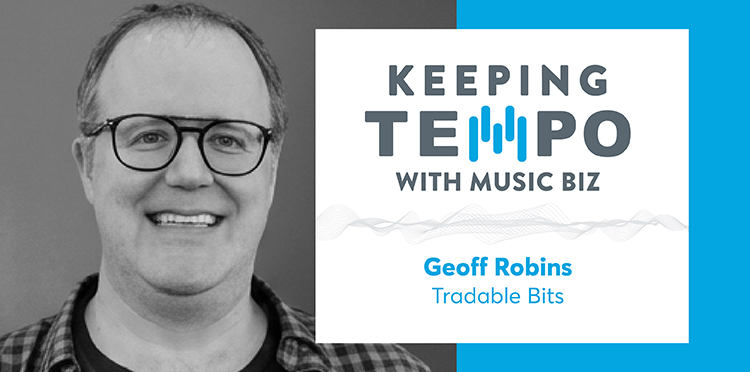
[Keeping Tempo With Music Biz] — When It Comes to Music, Value Isn’t Defined By the Ticket; It’s Defined By the Memory: Op-Ed from Tradable Bits’ Geoff Robins
For decades, the live music industry has mistaken price for value. Price became the story, amplified by headlines and press cycles, while value — the part that actually endures — left room for improvement.
As the market for live concert events matured, the industry moved to close what it saw as a pricing gap. Tickets had long been underpriced relative to what fans were actually willing to pay, and secondary markets made that obvious. So the focus shifted: dynamic pricing, premium tiers, and scaling structures built to capture more of that willingness at the top. The logic was sound from a revenue standpoint. But in the race to close the price gap, something got missed. All the energy around value was concentrated in two dimensions: “I can’t believe you got tickets” and “where did you sit?” Access and location. Proximity and prestige.
Ticket price became a proxy for status. It signaled access and exclusivity. Where you sat became a visible marker of importance, and that visibility was sold as the experience itself. But status is external; it’s what others see.
Value, on the other hand, is internal. It’s what fans feel and what they carry with them. What fans talk about is what happened. What felt different. What they got to be part of. “I was there when…” carries more weight than “I sat in section 102.”
The gap between status and value, or between price and memory, is what the industry is now addressing.
Travel Is Now Part of the Show
The clearest signal? Travel and entertainment have merged. What used to be a night out has become a multi-day, multi-layered destination. Festivals like Bourbon & Beyond from DWP blend music with bourbon tastings, culinary programming, and immersive fan activations that draw tens of thousands daily. Phish’s Riviera Maya residency turns a concert into a full-scale retreat with music alongside yoga, mezcal tastings, and shared experiences. Sixthman has built an entire business on this idea, transforming cruises into floating festivals like Headbangers Boat featuring Lamb of God.
Fans aren’t just attending anymore — they’re immersing, contributing, and building memories that extend far beyond the stage.
Bigger Isn’t Always Better
At the same time, not every artist is chasing scale. A sold-out backyard show hosted by LaRussell in Vallejo, California attended by an intimate crowd of 250 people offers a look from a different perspective. What they got wasn’t production. It was proximity, participation, and a sense of being part of something personal. That’s impressive for an artist with 100 million global streams.
That’s the counterweight to scale: intimacy.
Two Expressions of the Same Goal
What’s emerging isn’t a single approach, but a spectrum of immersive experiences. On one end: premium, high-touch environments designed to remove friction and elevate comfort, where every detail is curated to pull fans deeper into the moment. On the other: intimate, community-driven settings that strip things back and invite fans to participate, connect, and feel part of something personal.
From destination residencies to highly produced festivals to backyard shows, the common thread is immersion. Each approach creates a different kind of entry point, but all are designed to draw fans in – not just as spectators, but as participants in the experience.
The difference isn’t the value, but instead how that value is delivered.
The Middle Is Being Reimagined
Traditional, one-size-fits-all experiences are also evolving. Large-scale festivals are no longer just big. They’re becoming collections of smaller, curated moments, designed so fans can navigate their own path. Thousands of micro-experiences layered into one environment, each with the potential to feel personal. At the same time, smaller experiences are being designed to feel expansive, deep, immersive, and emotionally rich.
Simply put, the most forward-thinking organizations are simultaneously building both scale and intimacy.
How We Get There
The organizations getting this right are building systems to understand how fans actually behave across moments. They’re analyzing not only who bought a ticket, but also how they engaged before, during and after the event; what they chose to participate in; what they skipped and what they came back for.
The goal today isn’t just to sell out a show, but to design an experience people want to return to.
Instead of building a single, one-size-fits-all event, leading promoters are mapping the full spectrum of fan intent:
- The fan who wants seamless, premium access
- The fan who wants discovery and immersion
- The fan who wants intimacy and connection
These aren’t edge cases but distinct audiences with different expectations, and each one represents a different form of value.
The opportunity is to design for all of them, intentionally.
That means:
- Using data to identify who is participating in which experiences and why
- Structuring ticketing, upgrades, and packages around real behavior, not assumptions
- Creating modular experiences that can scale without losing meaning
- Aligning sponsors and partners to moments that actually resonate with specific fan segments
When done right, this not only improves the fan experience, but also compounds business outcomes.
Fans who feel understood stay longer, spend more over time, and are far more likely to return. They bring others with them. They engage beyond the event itself. The event is still the entry point, but the experience is what drives the business forward.
What Comes Next
The future of the live business will be about orchestrating both exclusivity and authenticity, not choosing between the two. About understanding how fans move across experiences, designing for relevance rather than just price point, and creating journeys that feel connected whether a fan is in a backyard, on a cruise, or in a VIP lounge.
The old model left the experience to chance. The new one is being designed deliberately, specifically, and with the memory in mind.
Because the future of fandom isn’t about being above the crowd, or even inside it. It’s about feeling like you belong, wherever you are.
Written by: Geoff Robins, VP of Product and Marketing, Tradable Bits
You can read past Keeping Tempo’ articles via the portal linked here. And, stay tuned for more insightful discussions from our members and partners from across the industry!