Event Recording Archive
Music Biz is proud to provide you with industry-defining data and commentary from our members and trusted research partners via recordings of our Common Ground Webinar Series, Music Biz Passport events, and other one-off virtual events!

November 5, 2026 – What Your Catalog is Worth and What Options You Have
Catalogs are worth more than most creatives realize. The growth of streaming has turned unpredictable income into something buyers and lenders can model, and that has changed both the number on the page and who’s willing to put capital behind it. This session — featuring Sound Royalties Founder & CEO, Alex Heiche and First Horizon Bank EVP, Andrew Kintz — will cover what drives the value of catalogs today and the main ways to leverage those assets. Bank lending and royalty advances have both been available for decades, and financing your catalog of music is more accessible than most people realize. Both are creative-friendly options, built around how music income behaves over time and the overall value of a catalog, but each one comes with different criteria and qualifications for funding. Choosing the “right” option depends on the catalog, the timeline, and what the money is for.
November 4, 2026 – Trust & Safety Tech Trendsetter: Part 1
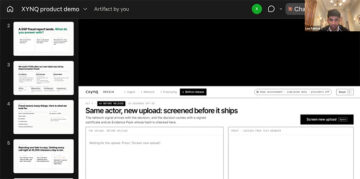
Music Biz and the MFFA have partnered to expand their annual Trust & Safety in Music Symposium with the new Tech Trendsetter Showcase webinar series supported by TuneCore! In addition to a short presentation from Brian Miller, Chief Business Officer at TuneCore, here are the companies that were featured during this first installment were XYNQ and Cadenza. XYNQ builds ORIGIN, a policy and compliance engine for automated content decisions. Every time a distributor, label or platform flags, removes or approves content, ORIGIN issues a cryptographically signed Evidence Pack showing which rule applied and why, so the decision can be audited and defended. XYNQ is based in Edinburgh and founded by Leo Fakhrul, who previously ran independent label Mamba Sounds (10M+ listeners). We're focused on helping the industry deal with streaming fraud and AI content at scale. Cadenza is a rights management platform that helps independent artists manage their entire catalog in order to protect their music, voice, and likeness. We compile catalog information, rights records, and evidence of usage to detect and investigate suspected unauthorized uses, misattributed releases, and likeness impersonation. Cadenza handles the administrative work end to end from detection to takedown or monetization. Artists maintain full control over which uses to authorize, monetize, or challenge, while retaining complete ownership and control over their work.
October 29, 2026 – How Rightsholders Can Unlock More Revenue from the Digital Music Economy
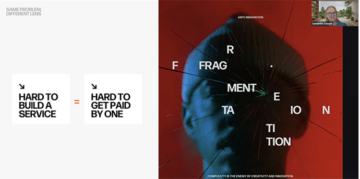
The music industry’s infrastructure has grown increasingly complex, and that complexity is costing rightsholders. Labels and publishers are leaving money on the table as platforms, apps and digital services struggle to navigate fragmented licensing, inconsistent metadata and slow rights clearances. This session explores the other side of that equation: what it looks like when rightsholders can effectively partner with infrastructure providers to reduce that friction, get their music into more products faster and ensure they’re properly reported to and paid. Drawing on MassiveMusic’s experience managing compliance, rights clearance and reporting for complex global deals, we’ll look at how rightsholders can launch into more services faster and ensure the revenue follows.

October 20, 2026 – Chartmetric’s “The New Sound of Global Music” Explores How Music Markets Are Breaking Borders
Just a few weeks ago, Chartmetric released "The New Sound of Global Music," a new report examining how five of the world's most dynamic music markets — Mexico, Japan, Brazil, India, and Nigeria — are building audiences beyond their borders. The globalization of music has never been more visible, but global availability doesn't necessarily translate into sustained international success. Some markets expand through neighboring countries and regional networks, others through diaspora communities or digital fandoms, while some have built domestic ecosystems powerful enough to sustain major artists largely at home. By analyzing foreign chart activity alongside the geographic audience breakdown of local artists, "The New Sound of Global Music" explores the extent to which music from each market is actually traveling and reveals five distinctly different models of globalization. Together, the findings demonstrate that there is no single blueprint for international music growth. Mexico has built a powerful regional network, Japan is beginning to convert domestic strength into international fandom, Brazil remains largely self-sustaining despite broad digital discovery, India combines enormous scale with geographically concentrated international audiences, and Nigeria has developed one of the widest cross-border footprints in the analysis. Join this webinar to discover where music is traveling, why it travels there, and how the world’s emerging music markets are reshaping the global industry.
October 15, 2026 – Provenance, Attribution and Detection: 3 Problems, 3 Different Technologies
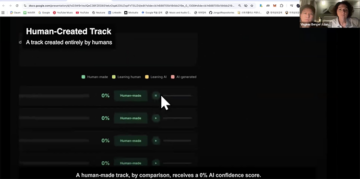
Provenance, attribution and detection get used interchangeably in almost every AI music conversation, and they shouldn’t be. Provenance asks where the musical material came from and what happened to it during the creation process. Attribution asks who contributed what. Detection asks whether AI was involved in creating it. Most of the industry uses these words interchangeably, and that’s a problem, because they’re solved by completely different technologies and they answer different questions. Understanding the difference matters for anyone trying to build workable rights infrastructure This session pulls the three apart. We’ll look at what each one can actually tell you, where each one breaks down, and why a platform, a label, or a rightsholder needs all three with concrete examples.
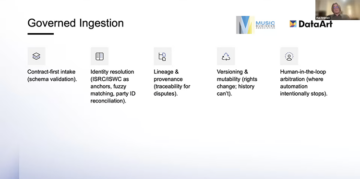
October 1, 2026 – Engineering Trust into Music Data: Our Approach to Governed Ingestion for Rights, Royalty, and Metadata Pipelines
Music data breaks down long before it reaches AI or analytics – it breaks at ingestion, where DDEX files, CWR registrations, and society royalty reports arrive in inconsistent formats with no shared validation layer. In this session, DataArt’s engineering team walks through our approach to solving that at the source: automated schema validation on arrival, standardized normalization across partners, and full audit trails before data ever reaches a warehouse, built on cloud-native infrastructure with a governed analytics layer downstream. We’ll show the architecture decisions behind this pipeline, what we’ve learned about building it, and how the same approach applies whether you’re modernizing legacy infrastructure or building fresh.

September 22, 2026 – Beyond Discovery: How Technology is Reshaping Independent Music Globally
With more than 120,000 songs uploaded to streaming platforms every day, it’s easy to assume that discovery of new talent is the biggest challenge affecting the music industry today. But for independent music rightsholders in emerging markets across Asia, Africa and Latin America, the real barriers lie elsewhere: limited local infrastructure for developing and promoting artists, scarce resources for independent labels and A&Rs to identify the right talent, and insufficient tools to build and activate fan communities. This panel will explore how tech platforms are providing scalable tools for talent discovery, roster development, marketing, data insights, community-building and direct-to-fan monetization. We’ll examine how technology is helping music rightsholders to operate more efficiently and compete globally, even in markets where industry infrastructure is still emerging but smartphone penetration and creator communities are growing at unprecedented speed.
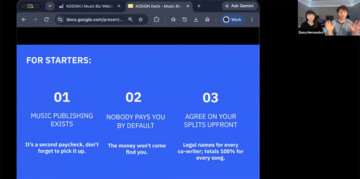
September 17, 2026 – What You Don’t Know About Publishing Is Costing You
An estimated $1 billion in songwriter royalties goes uncollected every year. KOSIGN wants to change that – getting those dollars to the songwriters who earned them, as quickly and directly as possible. Join team members Diana Hernandez and Jacob Paul as they walk through what you may be missing, including ROYALTIES.

September 3, 2026 – The Evolution of Music Ecosystems: Understanding Growth, Maturity and Global Influence through the MENA Music Ecosystem
Every music market is growing, but is every market truly evolving? Using the MENA region as a living laboratory, this session explores how music ecosystems develop from periods of rapid growth to institutional maturity and global influence. Through comparisons with ecosystems such as Nashville, Seoul and Lagos, participants will examine why music ecosystems facing similar technological, cultural and economic catalysts often follow very different trajectories, and gain a practical framework for understanding what enables sustainable ecosystem evolution—and why growth alone is not enough.

April 30, 2026 – The Publishing Hustle: Strategy, Admin & Co-Writing
Join Songtrust – a Downtown company – in a roundtable discussion with Nashville-based songwriters Becca Rae and Regan Stewart to unpack how to stay proactive in finding co-writes that move the needle and why publishing admin matters at every stage of your career.