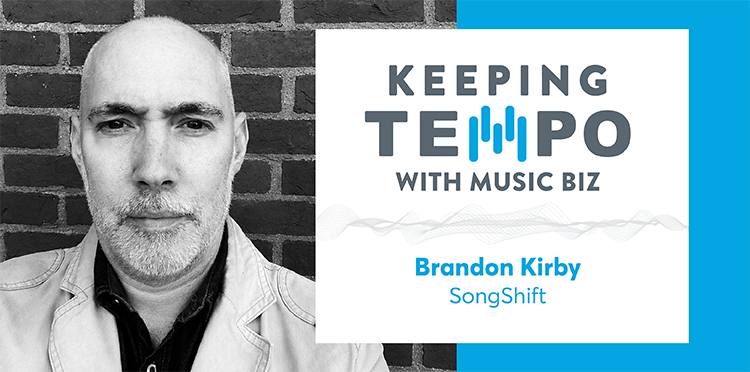
[Keeping Tempo With Music Biz] — AI is Making the Industry More Efficient (and More Fragile): Op-Ed from SongShift’s Brandon Kirby
Senior leaders across industries are under growing pressure to build leaner, faster, and more efficient teams and organisations. Advances in AI are accelerating expectations around productivity, automation, and operational scale at the exact moment teams are being asked to deliver more with fewer resources.
But many organisations are overlooking a far more consequential risk emerging underneath these changes.
As companies compress operational layers and reduce headcount, they also reduce many of the environments where leadership capability was traditionally identified and developed. Fewer entry-level roles, smaller teams, hybrid work, and leaner organisational structures all make it harder to observe who can make sound decisions, lead others effectively, and create alignment under pressure.
The result is a growing imbalance between how efficiently organisations operate and how effectively they identify leadership capability. Organisations are becoming more operationally efficient while simultaneously becoming more dependent on fewer people exercising better judgement in increasingly high-pressure environments.
That shift has major implications for how companies think about leadership, succession, talent development, and organisational resilience over the next decade.
The Great Compression
As companies become leaner and more operationally efficient, they are also becoming more compressed. There are fewer people, less redundancy, and more responsibility concentrated into each individual role. Managers influence a larger percentage of execution, communication, prioritisation, and coordination than they once did inside larger organisational systems.
This shift is already reshaping how organisations operate. Tasks that once required coordination across several people can increasingly be handled by one person supported by AI tools. Research, reporting, workflow management, and operational planning are all becoming more efficient, allowing organisations to maintain or even increase output without scaling headcount at the same rate they once did.
The pressure driving these decisions is understandable. Teams are expected to move faster, operate leaner, and deliver more with fewer resources than at any point in recent memory. But what often gets overlooked is that smaller, faster-moving organisations behave differently from larger ones. As responsibility concentrates into fewer roles, leadership quality begins to shape organisational performance more directly and more visibly than before.
The Music Industry Is Optimising Itself Into a Talent Problem
In the near future, many organisations will discover that operational efficiency does not automatically create organisational resilience. Increasing productivity while reducing headcount may improve margins and accelerate workflows, but it does not create stronger leadership systems, healthier decision-making cultures, or more adaptable organisations.
The organisations that struggle most in the next phase of change will not necessarily be the ones slowest to adopt AI. They will be the ones that failed to identify, develop, and properly assess the people responsible for leading increasingly lean and interconnected teams.
In short, operational capability is accelerating at extraordinary speed, while leadership capability is not evolving at the same pace.
That gap matters more than many organisations currently realise because leaner operating models behave differently from larger systems. In bigger and more layered organisations, weak leadership can survive for surprisingly long periods of time because strong individual contributors compensate for poor management, redundant structures absorb friction, and capability gaps remain partially hidden inside the organisation itself.
Leaner organisations do not have that protection.
As operational layers shrink and more responsibility becomes concentrated into fewer roles, leadership quality has a disproportionate effect on organisational performance. Weak prioritisation creates downstream confusion more quickly. Poor communication affects a larger percentage of the team. Delayed decision-making slows execution across increasingly interconnected systems. A manager who struggles to create clarity or alignment no longer impacts a small corner of the organisation. They affect the functioning of the system itself.
AI may reduce the number of people required to operate a business, but it does not reduce the consequences of putting the wrong person in charge.
For the music industry specifically, this shift is particularly significant. Many teams already operate in highly collaborative, deadline-driven environments where creative, commercial, and technical functions depend heavily on alignment and coordination. When teams become smaller and responsibilities broaden, the cost of miscommunication, weak leadership, or unclear prioritisation compounds much faster across the organisation.
The Visibility Problem
There is another consequence of organisational compression that receives far less attention, despite potentially being one of the most important.
Historically, organisations identified future leaders through repeated exposure over time. Meetings, projects, collaboration, travel, live campaign environments, and day-to-day operational pressures created opportunities for people to demonstrate initiative, judgement, communication ability, resilience, and influence.
Many of those opportunities are disappearing.
At the same time, hybrid and remote work environments have reduced many of the informal moments where leadership potential traditionally became visible. During and after COVID, many organisations unintentionally narrowed the environments in which people could demonstrate composure, initiative, or influence in real time. Visibility increasingly became dependent on proximity, presentation style, or managerial attention rather than repeated operational observation.
This situation creates a structural problem because leadership capability often only becomes visible after someone has already been promoted into a role where failure is expensive. The consequence is not simply weaker leadership. It is leadership potential that organisations increasingly fail to see at all.
The Rise of Invisible Talent
One of the most overlooked risks emerging from this transition is the rise of invisible talent.
Across the music industry, there are individuals who possess strong leadership potential but remain unidentified because organisations no longer have enough structured opportunities to observe how they operate under pressure, ambiguity, or coordination-heavy environments.
Technical competence, tenure, and historical execution performance remain heavily weighted indicators of advancement. Those signals become less reliable in faster-moving organisations where leadership increasingly depends on judgement, communication, prioritisation, and the ability to create clarity under pressure.
The result is a growing mismatch between the people organisations promote and the capabilities modern environments actually require. Many organisations are still evaluating leadership potential using signals designed for slower, more stable operating environments.
And those signals are no longer enough.
The Companies That Win Will Develop Leadership Differently
As organisations become leaner and responsibility concentrates into fewer roles, leadership quality begins to shape performance more directly than ever before. The companies that adapt best to this shift will not be defined by automation alone. They will be the ones that become better at identifying who can make sound decisions, lead others effectively, and create alignment under pressure.
In increasingly compressed organisations, those capabilities become a competitive advantage. They influence execution speed, adaptability, retention, trust, and the strength of the leadership pipeline itself.
The companies that ignore this shift may find themselves with more efficient organisations, but weaker succession pipelines, fewer ready leaders, and growing dependence on external hiring for critical roles.
As competition for experienced talent intensifies, the ability to accurately identify and develop leadership capability may become one of the defining advantages separating high-performing organisations from merely efficient ones.
The organisations that excel will treat leadership capability as something that must be surfaced intentionally, observed early, and developed before leadership gaps become operational liabilities.
Because in lean organisations, there is far less room to discover too late that the wrong people were promoted.
Written by: Brandon Kirby, Founder, SongShift
You can read past Keeping Tempo’ articles via the portal linked here. And, stay tuned for more insightful discussions from our members and partners from across the industry!