
November 5, 2026 – What Your Catalog is Worth and What Options You Have
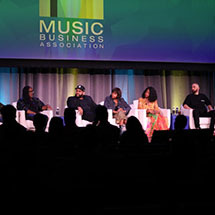
Catalogs are worth more than most creatives realize. The growth of streaming has turned unpredictable income into something buyers and lenders can model, and that has changed both the number on the page and who’s willing to put capital behind it. This session — featuring Sound Royalties Founder & CEO, Alex Heiche and First Horizon Bank EVP, Andrew Kintz — will cover what drives the value of catalogs today and the main ways to leverage those assets. Bank lending and royalty advances have both been available for decades, and financing your catalog of music is more accessible than most people realize. Both are creative-friendly options, built around how music income behaves over time and the overall value of a catalog, but each one comes with different criteria and qualifications for funding. Choosing the “right” option depends on the catalog, the timeline, and what the money is for.
October 29, 2026 – How Rightsholders Can Unlock More Revenue from the Digital Music Economy
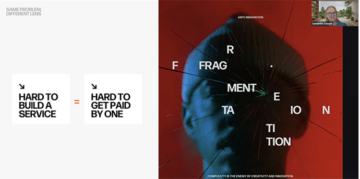
The music industry’s infrastructure has grown increasingly complex, and that complexity is costing rightsholders. Labels and publishers are leaving money on the table as platforms, apps and digital services struggle to navigate fragmented licensing, inconsistent metadata and slow rights clearances. This session explores the other side of that equation: what it looks like when rightsholders can effectively partner with infrastructure providers to reduce that friction, get their music into more products faster and ensure they’re properly reported to and paid. Drawing on MassiveMusic’s experience managing compliance, rights clearance and reporting for complex global deals, we’ll look at how rightsholders can launch into more services faster and ensure the revenue follows.
October 15, 2026 – Provenance, Attribution and Detection: 3 Problems, 3 Different Technologies
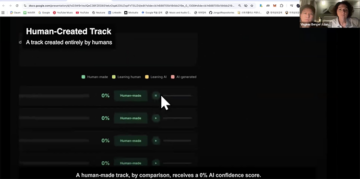
Provenance, attribution and detection get used interchangeably in almost every AI music conversation, and they shouldn’t be. Provenance asks where the musical material came from and what happened to it during the creation process. Attribution asks who contributed what. Detection asks whether AI was involved in creating it. Most of the industry uses these words interchangeably, and that’s a problem, because they’re solved by completely different technologies and they answer different questions. Understanding the difference matters for anyone trying to build workable rights infrastructure This session pulls the three apart. We’ll look at what each one can actually tell you, where each one breaks down, and why a platform, a label, or a rightsholder needs all three with concrete examples.
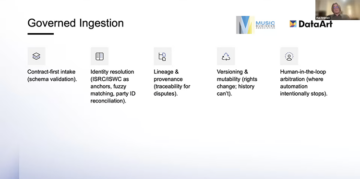
October 1, 2026 – Engineering Trust into Music Data: Our Approach to Governed Ingestion for Rights, Royalty, and Metadata Pipelines
Music data breaks down long before it reaches AI or analytics – it breaks at ingestion, where DDEX files, CWR registrations, and society royalty reports arrive in inconsistent formats with no shared validation layer. In this session, DataArt’s engineering team walks through our approach to solving that at the source: automated schema validation on arrival, standardized normalization across partners, and full audit trails before data ever reaches a warehouse, built on cloud-native infrastructure with a governed analytics layer downstream. We’ll show the architecture decisions behind this pipeline, what we’ve learned about building it, and how the same approach applies whether you’re modernizing legacy infrastructure or building fresh.
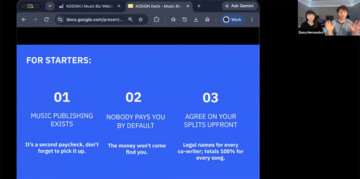
September 17, 2026 – What You Don’t Know About Publishing Is Costing You
An estimated $1 billion in songwriter royalties goes uncollected every year. KOSIGN wants to change that – getting those dollars to the songwriters who earned them, as quickly and directly as possible. Join team members Diana Hernandez and Jacob Paul as they walk through what you may be missing, including ROYALTIES.

September 3, 2026 – The Evolution of Music Ecosystems: Understanding Growth, Maturity and Global Influence through the MENA Music Ecosystem
Every music market is growing, but is every market truly evolving? Using the MENA region as a living laboratory, this session explores how music ecosystems develop from periods of rapid growth to institutional maturity and global influence. Through comparisons with ecosystems such as Nashville, Seoul and Lagos, participants will examine why music ecosystems facing similar technological, cultural and economic catalysts often follow very different trajectories, and gain a practical framework for understanding what enables sustainable ecosystem evolution—and why growth alone is not enough.

April 30, 2026 – The Publishing Hustle: Strategy, Admin & Co-Writing
Join Songtrust – a Downtown company – in a roundtable discussion with Nashville-based songwriters Becca Rae and Regan Stewart to unpack how to stay proactive in finding co-writes that move the needle and why publishing admin matters at every stage of your career.

April 23, 2026 – Transparency for the Modern Publishing Catalog: From Chaos to Clarity in Rights & Royalties
Today’s music catalogs demand transparency, accuracy, and real-time clarity — this session shows how RyteBox delivers the tools that empower informed decisions, confident reporting, and sustainable catalog growth: A contract solution built for the deals that drive the music business Real-time, actionable royalty reporting Comprehensive profit reporting A unified publishing and recorded music catalog The RyteBox Royalty Widget – a royalty allocation simulator

April 9, 2026 – Moments That Matter: How Real-Time Fan Engagement Shapes Modern Brand Deals
This webinar explores how split-second fan interactions—at shows, online, or during releases—are becoming powerful signals for brands deciding where to invest. We’ll look at how tech now captures these micro-moments and turns them into compelling brand storytelling and sponsorship opportunities. Attendees will learn how artists and managers can leverage fan energy in real time to attract stronger, more relevant partnerships.

March 26, 2026 – Roster Operations: Defining Work Intelligence in 2026
You’ve had people tell you to work smarter, not harder. But what does it mean to work intelligently? In today’s music ecosystem the tools exist to give business operators not only time-saving efficiencies, but the capability to make decisions armed with intelligence that isn’t possible with manual workflows. In the next two years, advances in AI and machine learning, and the integration of leading music software platforms across a variety of services will make manual data entry a thing of the past. The key to unlocking the true promise of these tools is ensuring your operation is integrated into the correct tech stack.